A scene of Hotline Miami, recreated in LEGO

Hotline Miami LEGO are two things which shouldn’t mix. One is an ultra-violent top down murder fest of a game, and the other is a made-for-kids interlocking bricks system. Luckily, Nannan Zhang does both properties justice with this little scene from the games.

Hotline Miami

Aside from the great colours used to imitate the game and the textured brick pieces being used as carpet details, what I really love is the fact that (as far as I can tell) only LEGO pieces were used. The Chima headpiece acting as a Tony Mask works particularly well. It all comes together so well and makes me want to play the games again.

Giant LEGO recreation of Force Awakens hangar holds four TIE fighters

Near the beginning of Star Wars: The Force Awakens, Poe and Finn hijack a TIE fighter and make their escape. The scene plays out in the hanger of the First Order’s star destroyer, the Finalizer. This hangar has been painstakingly recreated in LEGO by LegoSpencer in this project that took six weeks to create. The final build features four official LEGO TIE fighter sets as well as a few dozen stormtroopers and an untold amount of detailing. For a closer look, you can also check out the builder’s thorough breakdown video.

Adela the mystique beauty

High heels, white evening gloves, a red corset with black laces, a dark red cushion and an intriguing posture… This must be the exact definition of a goddess. Eero Okkonen sculpted the most thrilling character out of a handful of bricks and we are left to admire his talent and her beauty.

Adela

Micro-scale LEGO SLS rocket is ready for NASA’s Next Giant Leap

NASA Engineer and LEGO fan Nicholas Mastramico has brought us a most excellent follow up to the shuttle, launch pad, and SLS rocket we featured last week. Nicholas’s microscale version is eye-catching with the great detail he’s packed into such a small model. What makes his version particularly special is his relationship with the rocket: Nicholas is a structural design engineer for NASA, and is currently working on the real SLS rocket.

Untitled

This means his micro-SLS has a unique opportunity to stand in the shadows of its ancestors, like the Saturn V rocket pictured here.

Untitled

Nicholas says he’s always been a huge sci-fi fan – but it was the early pictures of Mars from Sojourner that truly hooked him on space travel. He decided then he would build rockets for NASA one day, and that goal guided him through school to where he is now. He was recently involved in a test with a weather balloon, for which he provided a passenger. The experiment took the minifig up to 120,000 feet!

Untitled

There are more shots of some of the features of the mobile launch platform and payload capsules, as well as an itty-bitty adorable crawler!

Bringing Imperial order to the wretched hive of scum and villainy

Nikolai Mordan has built this awesome diorama of an Imperial base on Tatooine. It makes a fantastic backdrop for displaying LEGO’s UCS Imperial Shuttle, which looms ominously over the squads of stormtroopers and Imperial officers bringing the Imperial arm of order to the backwater oasis of Mos Eisley. I hope they find those droids they’re looking for.

IMGP5462

Nikolai built this as part of a collaboration displayed at Wintercon, a Latvian geek convention.

IMGP5466IMGP5472IMGP5465
IMGP5470

LEGO Concorde cuts away from the runway as 65,000 bricks take flight

LEGO Certified Professional Ryan McNaught has been busy unveiling some fantastic new creations at Brickvention Australia. We showcased his incredible LEGO minifig-scale 120,000-brick sinking Titanic, and now we take to the skies with LEGO Concorde.

Ryan has chosen to build the iconic supersonic aircraft Concorde in miniland-scale. Building  Concorde in LEGO is cool, but it’s only when you see the other side of the build that the really impressive details emerge.

LEGO Concorde

While one side shows the complete aircraft, the other is an ingenious cutaway view that shows a slice through Concorde.


LEGO Concorde

At just over 4m long (over 13 feet) and some 65,000 bricks, Concorde took Ryan and his team 188 build hours to complete.  The cutaway view includes all sorts of great touches; the cockpit with knobs and switches, a galley area with croissant ready to serve, a jumble of luggage in the cargo hold and the inner workings of the landing gear.

LEGO Concorde

Check out the massive engines on this supersonic beast.

LEGO Concorde

I couldn’t spot any snakes on this plane…

What happens when Zeus gets into your LEGO

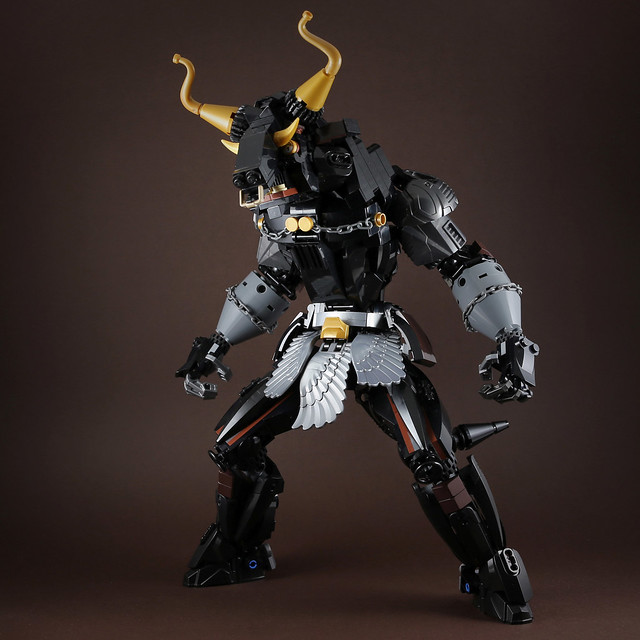
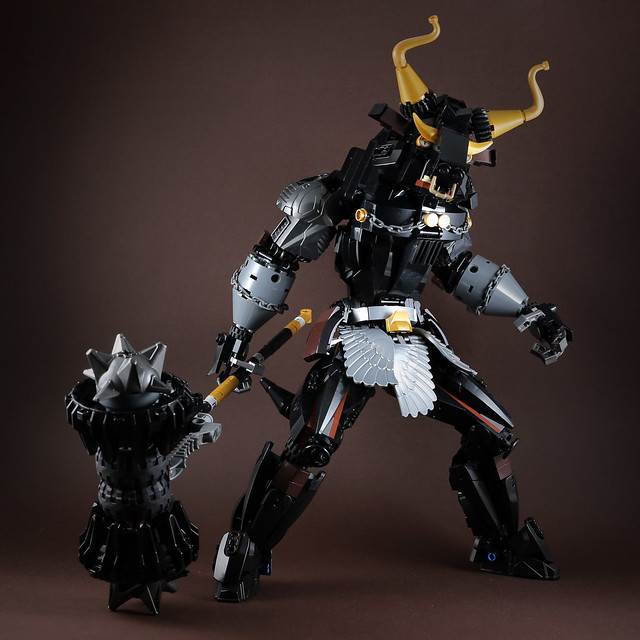
Dragons? Werewolves? Mermaids? Nope, the best mythological creature is obviously the minotaur (in my opinion, anyway). That may be why I had a soft spot for 70793 Skull Basher and why I love this “Cattle Devil” by LEGO 7.

Cattle devil-2

Parts use is great here: constraction armour pieces used to represent exactly that, wing pieces for the skirt, the bucket handle for a bottom pair of teeth and a lot more.

Also check out the weapon:

Cattle devil-1

100 years of Starbucks in LEGO

WingYew takes us time traveling in an unnamed city with a MOC that spans a hundred years, from the arrival of streetcars to the proliferation of megachains. The dueling coffeeshops are replete with excellently detailed interiors and give a striking sense of how little has changed – and exactly how much has changed.

LEGO MOC - Now and Then

MOC Starbucks (15)

LEGO MOC - Penang Heritage Shop

How-to: Tools of minifig customization – Confessions of a customizer (Part II)

In our first guest post from Jasbrick, we learned about how to get started with minifig customization. Now, let’s hear what he has to say about the tools of the trade.

Now that you have a concept and have gone as far as you can by conventional means it is time to bring in the tools. The range of customisation techniques mean that even with limited tools you can get some pretty impressive results without breaking the bank.

Painting and re-colouring

RAF 100th Steamsuit SquadronI use painting to add details or re-colour parts that would not otherwise be possible.

For example the following minifig fits the steampunk genre with its almost rust / bronze coloured metallic effect which would have been impossible with the original bright white Buzz Lightyear original scheme.

Those of you who have everything you need but with parts that are not quite in the colour you want have two options: Dyeing or Painting.

Dyeing using vinyl dyes works well with parts that you want to change completely, but is limited in colours available and achieving a particular tone can be tricky.

Painting can offer more flexibility in colour choice and coverage, however the biggest downside is that painting plastic is difficult. I see examples every day of great custom concepts that are ruined by the quality of the painting. As painting is a favourite technique of mine I will go into much more detail on this and how to avoid creating a dull, streaked and unconvincing paintjob.

The key tools you need for painting are shown in the image below:

Painting Equipment

  1. Spray undercoat (essential for smooth painting on a plastic surface);
  2. Games Workshop Foundation paints (high opacity paints that give a good coverage with a single coat;
  3. Games Workshop Normal paints (good range and availability);
  4. Privateer Press P3 paints (slightly better quality than GW paint in my opinion, smaller range of colours and poor availability);
  5. Vallejo Paint (Excellent range of paints that also has colour range that is named after military colour schemes e.g. Lluftwaffe Blue);
  6. My device for holding helmets / heads for painting;
  7. Games Workshop brushes of various sizes.

The most crucial of all is the spray primer, as painting a smooth coat onto plastic is virtually impossible without it. Spray primer covers the part with a very thin layer of paint which is much more likely to bond with the plastic and not scratch off easily. Subsequent coats of paint adhere to this base and settle without streaks or chipping. So if you want a minifig helmet to be a nice shade of dark blue to match your plan for a Judge Dredd figure then you need to spray it before applying the perfect paint colour.

Your choice of paints is also important and I suggest you experiment with different types before applying to a Lego part. Characteristics like price, coverage, mixing, drying time, finish and colour choice all need to be considered. I personally use the Games Workshop model paint range as they score highly on all of the above criteria (except price). Games Workshop also have a great range of inks for washing and foundation paints for good coverage. Other good ranges are Vallejo and Privateer Press P3. All of these sell starter sets which contain a good selection of paints and brushes to get you started.

With paint brushes it is not just about size but how you use them that counts… You will need to have good quality model brushes in three main sizes: fine detail, standard and basecoat. Working out the right brush for the job is essential as a small brush will not cover a large area as smoothly as a basecoat brush. As with most things brush control improves with practice and it is advisable to test your new skills on something less precious than your rare minifig part. The following is an example of fine brush work:

Luchador: British Bulldog

This wrestler’s mask was painted freehand with a fine detail brush in multiple layers.
Jasbrick Joker V2

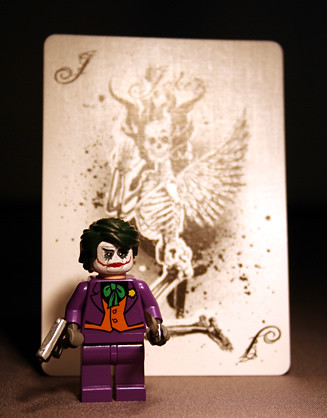
The joker here has face details that were painted on freehand and the hair which was primed and then painted with a dark green colour using a basecoat brush.

Painting detailed designs requires not only brush control but paint control as well. Another obvious problem in some custom work is the thickness of paint application and poor layering. Experience in handling paint can be shortcut by the use of a tool known as a Wet Palette. These are so easy to put together and it is definitely going to improve your paintwork. Quite simply all you need is a small tray, about the size of an 8 x 16 brick, and some absorbent cloth or paper towel. Put the cloth in the tray and then add water to it until the cloth is completely damp… That is it, now all you need to do is transfer your paint to the wet palette before painting on the part. The damp cloth waters down the paint slightly, keeps the paint from drying and also allows you to mix with more control.

There are a whole host of tutorials on the internet for how to create a wet palette and how to paint, however I hope to bring more Lego-specific tutorials to you in the near future.

An important part of painting is the final finish. Paint applied properly will be more resilient than you think possible. However, to seal the deal you can use a varnish to protect your work. Varnishes can be matt or gloss, with the latter being particularly useful for returning a shine comparable to pure unadulterated plastic.

How-to: Confessions of a minifig customiser – Part I: Getting started

As we say in our AFOL jargon glossary, purism is “a form of religious fundamentalism.” LEGO fandom includes a broad range of preferences for what’s “legal” and what’s not. In the spirit of broadening our horizons, we’re very pleased to bring you the first in a series of posts about LEGO minifig customization by master customizer Jasbrick.

Light Tent TestContrary to popular belief customisation of minifigs is not a dark art and even established purists have tried their hand at slapping some paint around (albeit on the Friends Mini-dolls). Some will never stoop to the mutilation of their favourite brand of ABS plastic, however I do believe that if done properly it can at least be appreciated by all.

The Brothers Brick have given me the opportunity to introduce you to some of the tools and techniques of my trade to help those amongst you that have the desire to walk on the dark side for a while. In later posts I will go into specific techniques that I developed in my time as a customiser. Hopefully you can benefit from avoiding the pitfalls I fell into and get a few projects like these underway:

New Gears of War 3

These minifigs involve more advanced painting techniques and some third party accessories.

Monster Manual Player Power

This group utilises painting, combinations, third-party accessories and printed decals.

Establishing a strong concept design

One tool a customiser must have is a highly developed imagination (something pretty common in the Lego community); everything else is optional.

Off to Afghanistan!Those moments when putting a particular combination of parts together and a perfect fig pops out are wonderful, but about as rare as chicken dentures. The key to a good custom project is pre-planning and a well defined concept. This does not have to be something completely new, as for example computer game concept art offers a rich seam of material to be interpreted, or real life inspiration can be just as good. The minifig on the right was created for a Green Beret Major currently serving in Afghanistan who sent me a photograph of himself to copy.

But if you want to start from scratch then a sketchpad is your best friend. You don’t even need to be good at drawing to develop a decent concept due to the simplicity of the design of our little friend the minifig. As this series develops I hope to be able to share with you some of the concept designs that I have developed and how they become a reality. Alternatively you can sketch your concept over a template like this:

Collectable Minifig Design Interview

Once the concept is set (not in stone, but pretty solid) the next step for me is to determine how much of this can be achieved with standard parts or by utilising third party accessories. I will be delving deeper into how to get the best from suppliers such as BrickArms, BrickForge, Brick Warriors and Arealight later, but I highly recommend checking out these companies as they offer a great range of products that can serve as inspiration in themselves.

Parts Library

As an AFOL who has amassed quite a large collection of minifig parts and accessories I have a library that I can dip into that can make most custom projects a matter of tweaking to get the final effect rather than building everything from scratch.

The following image is a recent group of minifigs that I put together that are without any noticeable customisation. I managed to achieve a lot with just the combination of parts and a few third party accessories thrown in to tie the concept together:

Odysseus Crew need ship

I recommend that you take a close look at the Minifig and Minifig parts areas in the catalog on Bricklink and see which figs / parts speak to you of further opportunities. Developing an inventory of useful parts is essential to allowing you to get projects moving swiftly before your enthusiasm for the concept dies.